
Executive Summary
Selecting an enterprise top HRMS platform in India requires evaluating core data models, statutory engine flexibility, multi-entity scalability, and middleware integration capacity. This comparative architecture guide breaks down India’s leading enterprise HRMS solutions:
-
Architectural Unity: Eliminating module-to-module data reconciliation overhead through single-data-model platforms.
-
Localization Precision: Guaranteeing strict compliance with evolving pan-India tax, Provident Fund (PF), and ESI regimes.
-
Integration Scalability: Enforcing event-driven middleware architectures to connect HR systems seamlessly with enterprise ERPs.
Navigating the Indian Enterprise HRMS Ecosystem
The enterprise HR technology market in India has evolved rapidly from basic payroll processing tools into complex systems of intelligence. Enterprise leaders managing multi-entity organizations, distributed field workforces, and rapid regional expansion can no longer treat HR software as a simple administrative record keeper. Selecting the wrong platform introduces severe operational friction, payroll inaccuracies, and fragmented workforce data that throttles strategic decision-making.
Choosing an enterprise-grade platform requires analyzing how well the underlying database schema handles the unique complexities of the Indian business landscape. As a specialized hr tech consulting firm and recognized leader in hrms consulting india, MainStay Consulting routinely conducts deep architectural evaluations for CHROs and CIOs. By auditing data schemas, integration readiness, and long-term total cost of ownership, consulting specialists help enterprise leadership navigate vendor claims and build resilient, future-proof human capital ecosystems.
According to the Gartner 2026 Magic Quadrant for Cloud HCM Suites, modern enterprise buyer criteria have shifted decisively toward platforms offering unified data models and rapid, HR-led policy configurability. Evaluating platforms through this architectural lens prevents costly re-implementation cycles and protects gross operating margins.
Core Evaluation Criteria for Modern Enterprise HR Architecture
Evaluating an enterprise HRMS requires inspecting the underlying platform physics. Enterprise technology leaders must evaluate four non-negotiable architectural pillars before committing to a platform vendor.
1. Single Data Model vs. Modular Aggregation
Legacy enterprise suites often consist of acquired modules patched together through internal APIs. This modular aggregation forces HR and finance teams to execute frequent data reconciliations between core HR, time tracking, and payroll modules. Conversely, platforms engineered around a single unified data model store employee attributes once, allowing changes in attendance or compensation to cascade instantly across the entire ecosystem without audit overhead.
2. Multi-Entity Dynamic Matrix Hierarchy
Indian enterprises frequently operate complex web structures involving legal subsidiaries, offshore development centers, and specialized field units. The HRMS must natively support dual-reporting structures—distinguishing an employee’s administrative manager from their functional project manager—without breaking approval workflows or performance appraisal loops.
3. Pan-India Statutory Rules Engine
Indian statutory compliance is highly volatile across states. From state-specific Professional Tax (PT) slabs and Labour Welfare Fund (LWF) contributions to complex Provident Fund (PF) wage capping rules, the system’s rules engine must automatically process localized statutory updates without requiring custom code development.
4. Asynchronous Integration Capability
An enterprise HRMS must communicate in real time with financial ERPs, active directory systems, and access control hardware. Platform architectures that lack event-driven webhook buffering risk dropping data payloads during high-volume events like month-end attendance locking or annual appraisal rollouts.
Architectural Breakdown of Leading Enterprise HRMS Solutions
Evaluating top HRMS platforms requires analyzing how each platform addresses the operational realities of mid-sized and large Indian enterprises.
+-----------------------------------------------------------------------------------+
|                        INDIAN ENTERPRISE HRMS SPECTRUM                            |
+-----------------------------------------------------------------------------------+
                                         |
     +-----------------------------------+-----------------------------------+
     |                                   |                                   |
     v                                   v                                   v
+--------------------------+  +--------------------------+  +--------------------------+
| Native Asia/India Suites |  | Global Legacy Enterprise |  | Mid-Market/SMB Platforms |
| (e.g., Darwinbox)        |  | (e.g., Workday, SAP)     |  | (e.g., Keka, GreytHR)    |
+--------------------------+  +--------------------------+  +--------------------------+
| • Native multi-entity    |  | • Global financial depth |  | • Rapid deployment       |
| • High policy flexibility|  | • High implementation cost|  | • Low initial TCO        |
| • Built for SEA/India    |  | • Complex IT governance  |  | • Rigid schema limits    |
+--------------------------+  +--------------------------+  +--------------------------+
Darwinbox: The Native Multi-Entity Challenger
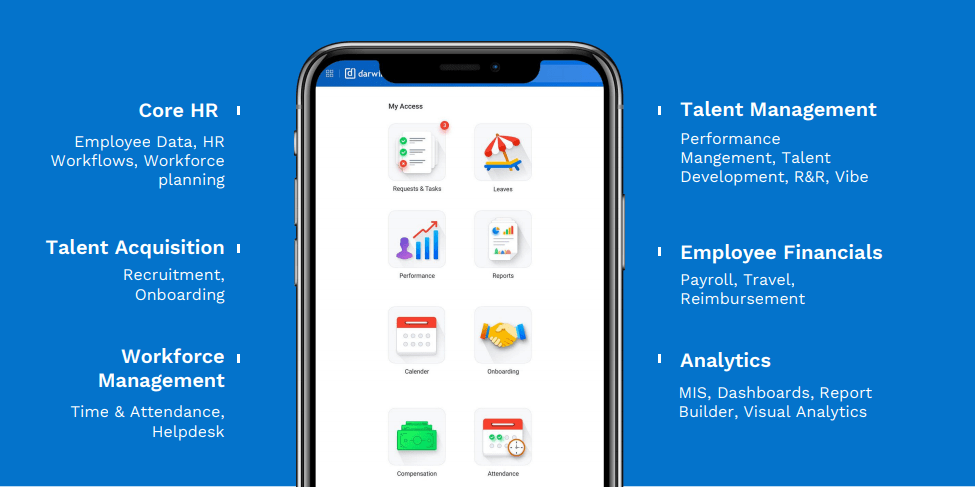
Darwinbox has established itself as a leading cloud HCM platform for mid-market and enterprise organizations across India and emerging global markets. Built natively around a single data model, it offers no-code workflow configurability, allowing HR administrators to adapt policies, approval hierarchies, and localized forms without continuous IT intervention. Its native India payroll engine handles complex statutory variations effortlessly, making it particularly strong for multi-entity firms operating at scale.
Workday: The Global Financial and Planning Anchor
Workday remains a dominant global suite for large multinational corporations, particularly those requiring deep integration between core HR, financial planning, and enterprise resource planning (EPM). Its skills ontology and board-grade reporting capabilities are highly mature. However, for Indian mid-market enterprises, Workday’s high implementation costs, longer deployment cycles, and reliance on partner-managed payroll extensions can increase total cost of ownership.
SAP SuccessFactors: The Legacy ERP Suite Extension
SAP SuccessFactors provides deep global human capital management capabilities and is frequently chosen by large enterprises already running core SAP ERP infrastructure. While its global statutory breadth is extensive, configuring local policy changes often requires specialized partner-led ABAP or Cloud Platform Integration (CPI) scripting, resulting in a slower pace of workflow adaptation.
Keka and GreytHR: High-Velocity Mid-Market Solutions
Platforms like Keka and GreytHR excel in the small-to-mid-market segment (<1,000 employees). They offer rapid, template-driven deployment and intuitive user interfaces for standard payroll and attendance tracking. However, when an enterprise expands into multi-entity matrix structures, complex sales incentive structures, or requires deep event-driven API integrations, these platforms encounter architectural schema limits.
Solving the Enterprise Integration Bottleneck
The true test of an enterprise HRMS is its ability to co-exist within a broader corporate application stack. An isolated HR platform creates operational friction, forcing finance and IT teams into manual data reconciliation.
+-----------------------+      +-----------------------+      +-----------------------+
|  Darwinbox HRMS       | ---> | Integration Gateway   | ---> | Core Enterprise ERP   |
| (Source of Workforce  |      | (Idempotent Buffers & |      | (SAP / Oracle / NetSuite|
|  Truth & Attendance)  |      |  Event-Driven Queues) |      |  General Ledger)      |
+-----------------------+      +-----------------------+      +-----------------------+
Eliminating the Integration Tax
When HR platforms push payroll, new hire, or termination data to backend ERP systems via brittle point-to-point scripts, network timeouts inevitably cause data drops. To eliminate this “integration tax,” enterprise architects deploy resilient middleware buffers.
As highlighted in The Economic Times 2026 Enterprise Transformation Analysis, modernizing enterprise workflows requires transitioning from basic systems of record to systems of intelligence backed by robust, decoupled integration pipelines.
Partnering with specialists in enterprise systems integration india ensures that outbound HRMS webhooks pass through cryptographic validation and rate-limiting queues, guaranteeing that payroll numbers in the HRMS match backend financial ledgers to the exact rupee.
Establishing Long-Term HCM Governance
Selecting an HRMS is a multi-year strategic commitment. Platform capabilities evolve, regional business units expand, and internal HR processes adapt to changing labor trends.
Without active governance, even the most advanced HCM platform suffers from configuration drift over time. Internal teams add ad-hoc custom fields, bypass standard approval rules, and fail to utilize new platform updates. Enterprise organizations must establish continuous Application Managed Services (AMS) protocols to maintain data sanity, continuously calibrate statutory rules engines, and ensure high user adoption across all operational tiers.
Architecting Your Enterprise HCM Roadmap
Evaluating HRMS platforms requires looking past surface-level feature checklists and auditing the core data models, integration resilience, and statutory governance capabilities of each vendor. By aligning software architecture with your organization’s exact multi-entity physics, enterprise leaders build a scalable, high-velocity talent command center.
To re-architect your enterprise HR ecosystem and evaluate platform fit with total clarity, engage with our domain experts at our HR Systems Enterprise Consulting practice.