
Executive Summary
Integrating enterprise payroll software engines with India’s complex statutory tax and Provident Fund (PF) regimes requires real-time rules engine configuration, automated calculation logic, and secure ledger synchronization:
| Statutory Regime | Compliance Mandate | Integration Requirement |
| Employees’ Provident Fund (EPF) | Dynamic EPS/EPF Split & Wage Capping | Automated ECR File Generation |
| Income Tax (TDS / Sec 192) | Dual Tax Regime Evaluation (Old vs. New) | Real-Time Investment Proof Auditing |
| Professional Tax (PT) & ESI | State-Specific Thresholds & Slabs | Automated Multi-State Policy Mapping |
-
Zero-Defect Calculation: Programmatically processing retroactive wage revisions and statutory caps without manual Excel interventions.
-
Direct ECR Sync: Generating error-free Electronic Challan-cum-Return (ECR) data directly from core payroll tables.
-
Audit-Ready Trail: Preserving immutable ledger snapshots for seamlessly passing statutory PF and Income Tax audits.
The Complexity of Pan-India Statutory Payroll Governance
Indian enterprise payroll is among the most structurally complex statutory regimes in the world. Managing payroll across multiple Indian states requires complying with a moving target of localized Professional Tax (PT) slabs, Labour Welfare Fund (LWF) contributions, Employee State Insurance (ESI) eligibility thresholds, and statutory Provident Fund (PF) wage capping. Furthermore, the dual tax regime under Section 192 obligates organizations to continuously recalculate Tax Deducted at Source (TDS) based on real-time employee regime declarations and investment proof verification.
When mid-sized and enterprise firms scale, manually calculating these statutory variations across disparate spreadsheets or unintegrated payroll plugins creates massive operational friction. As a recognized authority in hrms consulting india, MainStay Consulting routinely re-architects enterprise HR and payroll environments. By configuring automated statutory calculation engines and building fault-tolerant middleware, specialized integration teams eliminate payroll discrepancies and ensure strict compliance with Central Board of Direct Taxes (CBDT) and Employees’ Provident Fund Organisation (EPFO) regulations.
According to a 2026 Economic Times report on digital payroll compliance in India, enterprise organizations that automate multi-state statutory rules engines reduce payroll audit query cycles by over 70% while completely eliminating late-filing penalty fees.
Architectural Pitfalls in Traditional Payroll Integration
Legacy payroll software frequently relies on static, hardcoded rules to process tax deductions and statutory contributions. This brittle architectural approach breaks down the moment statutory authorities revise thresholds or when an employee transfers across state boundaries mid-year.
The Friction of Manual ECR Generation and PF Wage Capping
The EPFO requires employers to submit monthly Electronic Challan-cum-Return (ECR) files detailing pension (EPS) and provident fund (EPF) contributions. The underlying calculation involves strict logic: cap eligibility at ₹15,000 basic salary, split contributions between EPF (3.67%) and EPS (8.33%), handle voluntary provident fund (VPF) top-ups, and account for non-qualifying allowances.
When legacy software exports raw, unvalidated CSV files for ECR upload, minor rounding errors or mismatched Universal Account Numbers (UAN) cause the EPFO unified portal to reject the submission. HR teams then waste days performing manual line-by-line reconciliations under tight statutory filing deadlines.
Managing Dual-Regime Income Tax Calculations at Scale
Under Section 192 of the Income Tax Act, Indian employers must offer employees the choice between the Old Tax Regime (with itemized deductions under 80C, 80D, HRA, and LTA) and the New Tax Regime (with lower slab rates and standardized deductions).
A static payroll system forces manual tax computations whenever an employee submits mid-year investment proofs or changes regimes. An enterprise-grade architecture, by contrast, deploys an automated comparison engine that continuously evaluates an employee’s dynamic tax liability under both regimes, calculating precise monthly TDS deductions automatically.
Integrating Core HRMS with Statutory Policy Engines
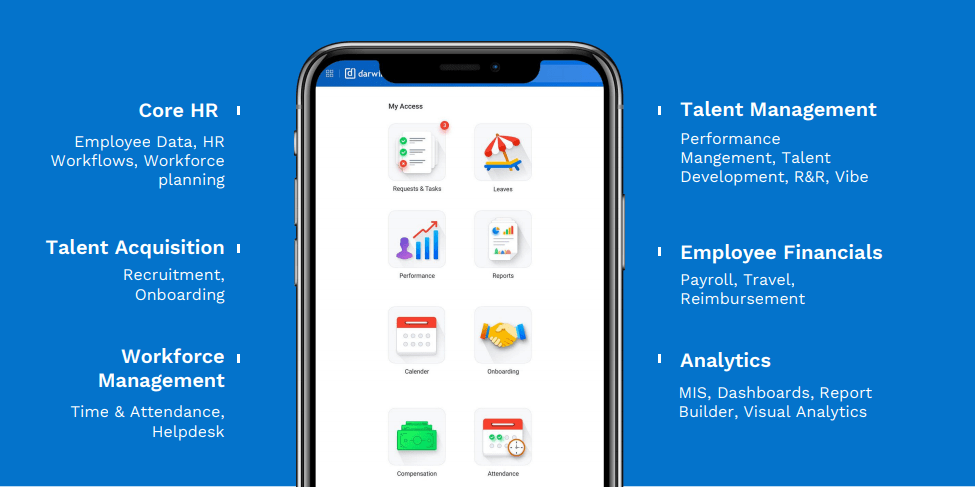
To achieve continuous compliance, enterprise organizations must decouple the payroll calculation engine from static software code, embedding it within an agile, configurable policy framework inside platforms like Darwinbox.
+------------------------+      +------------------------+      +------------------------+
|  Core HRMS & Time Data | ---> |  Statutory Rules Engine| ---> | Government Portals     |
| (Attendance, Leaves,   |      | (Pan-India Tax/PF/ESI  |      | (EPFO ECR, TRACES,     |
|  Salary Revisions)     |      |  Policy Configuration) |      |  State PT Portals)     |
+------------------------+      +------------------------+      +------------------------+
Dynamic Multi-State Policy Mapping
When an employee transitions from an office in Maharashtra to a branch in Karnataka, their Professional Tax deduction rules change instantly. In an integrated architecture, the HRMS reads the employee’s updated work location attribute and automatically applies the correct state-specific PT slab without requiring manual payroll reconfiguration.
By leveraging expert darwinbox consulting services, enterprise leaders configure these complex multi-state matrices directly into the core HCM workflow. This guarantees that monthly statutory deductions execute with zero manual intervention, regardless of workforce movement or branch expansion.
Automated Investment Proof Auditing
The end-of-year tax proof submission window creates immense administrative pressure for HR and payroll teams. Integrating OCR-driven document verification into the payroll portal allows the system to validate HRA rent receipts, 80C investment certificates, and home loan interest statements automatically against submitted declaration values. Discrepancies are flagged instantly to the employee, ensuring the payroll engine computes final Form 16 (Part B) values with absolute precision.
As noted in recent coverage by Business Today on enterprise HR tech trends, deploying automated tax verification gateways reduces end-of-year payroll administrative overhead by over 60%.
Engineering Resilient Financial Ledger Sync for Payroll Data
Calculating compliant payroll numbers is only the first half of the statutory equation. The resulting payroll liabilities—broken down by cost center, department, tax head, and statutory account—must sync cleanly into the backend Enterprise Resource Planning (ERP) ledger (such as SAP, Oracle, or NetSuite).
Preventing General Ledger Discrepancies
When payroll outputs are manually exported and re-keyed into accounting systems, formatting errors and misallocated cost centers corrupt the general ledger. To prevent this, enterprise systems use decoupled integration pipelines.
Through robust enterprise systems integration india practices, middleware gateways automatically transform payroll outputs into double-entry accounting journal vouchers. The integration layer verifies that debits and credits match across all statutory heads before committing the transaction to the ERP, preserving total financial data parity.
Guaranteeing Uncompromising Statutory Compliance
Operating an enterprise in India demands absolute accuracy in statutory tax and payroll management. By abandoning fragmented spreadsheets, configuring dynamic statutory policy engines inside modern HCM platforms, and securing integration pipelines with backend financial ledgers, enterprise leaders safeguard their business against compliance penalties and administrative paralysis.
To modernize your payroll software architecture and ensure total statutory tax compliance, explore our specialized solutions at our HR Systems Enterprise Consulting practice.