Executive Summary
In fast-scaling IT services organizations, fragmented employee records create severe administrative drag, billability leaks, and security vulnerabilities. Transitioning to a centralized, cloud-based HRMS replaces disconnected spreadsheets and localized regional databases with a single, real-time workforce data model:
-
Unified Identity Mapping: Binding employee profiles, certifications, and project histories to a single immutable identity record.
-
Zero-Latency Sync: Automatically pushing real-time headcount and allocation updates to downstream ERP and IT provisioning platforms.
-
Statutory Sanity: Centralizing localized labor and tax compliance rules across multi-region IT delivery hubs.
The High Cost of Data Fragmentation in IT Services
IT services firms operate in high-velocity, dynamic environments where talent allocation directly dictates profit margins. A single senior full-stack engineer might be legally mapped to a European delivery subsidiary, physically seated in an offshore development center in Hyderabad, and operationally assigned to a multi-month client project based out of North America. When employee records are scattered across disconnected HR software, local payroll spreadsheets, and decentralized project management portals, operational visibility collapses.
Managing employee records across fragmented tools forces human resource, finance, and resource management teams to act as manual data reconcilers. When an engineer earns a new cloud architecture certification or switches legal entities, that update must be manually keyed into multiple disconnected databases. This manual administrative drag leads to data decay, where different departments hold conflicting records for the exact same employee.
As a recognized hr tech consulting firm and advisory specialist, MainStay Consulting regularly conducts data lineage audits for mid-market and enterprise technology firms. These audits consistently reveal that data fragmentation actively depresses billable utilization. When resource managers cannot query a centralized, real-time skills and profile directory, billable bench resources sit idle while project managers scramble to hire expensive external contractors.
Four Structural Mechanisms of Cloud Data Centralization
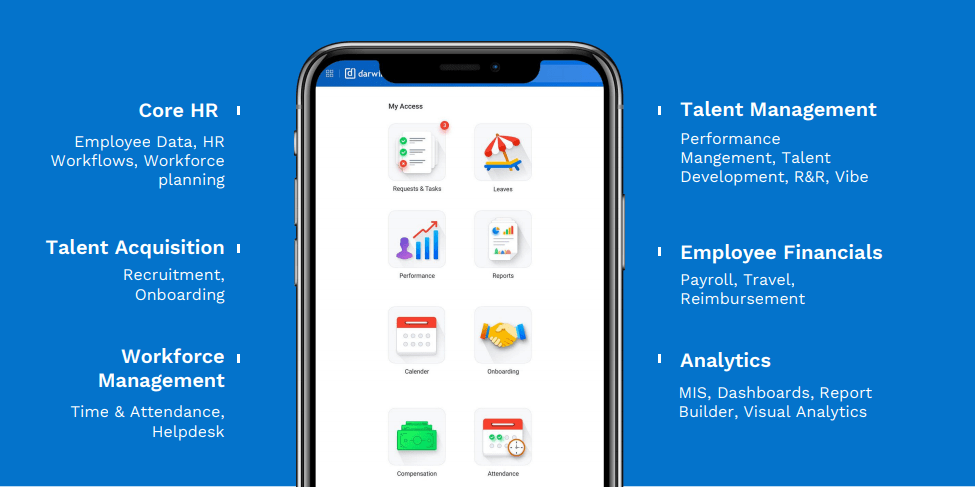
Cloud-based HRMS platforms—such as Darwinbox—solve the data fragmentation crisis by replacing ad-hoc software modules with a unified, relational data architecture. Understanding how cloud architectures centralize employee records requires examining four underlying system mechanics.
1. Single Source of Truth and Database Normalization
Legacy HR setups usually evolve through piecemeal software purchases: one application for recruitment, another for attendance tracking, a local tool for payroll, and static spreadsheets for skills inventories. Each tool maintains its own isolated database, requiring periodic batch syncs or manual exports.
A modern cloud HRMS utilizes a fully normalized, single data model. Every employee attribute—from personal identity verification details and compensation history to daily shift logs and performance appraisals—is anchored to a unique, immutable primary key. When an employee updates their residential address or emergency contact in the self-service portal, that single modification automatically updates core HR, payroll calculation engines, and emergency notification systems simultaneously without requiring middleware synchronization scripts.
2. Real-Time Role-Based Access and Schema Governance
In a fragmented data environment, sensitive employee information—such as salary details, performance ratings, and government ID numbers—is frequently shared via unencrypted email attachments and localized spreadsheets. This creates massive data governance liabilities and exposes the firm to severe regulatory penalties.
Centralized cloud architectures enforce strict Role-Based Access Control (RBAC) and Field-Level Security (FLS) directly at the database schema layer. System administrators configure granular permission matrices where a functional project manager can view an engineer’s technical skills and current project allocation, but remains strictly blocked from viewing their confidential compensation records or personal medical leave notes. Data security is maintained at the point of access without hindering daily operational workflows.
3. Automated Cross-System Synchronization via Event-Driven Webhooks
Centralizing employee records inside the HRMS does not mean isolating that data from the rest of the enterprise technology stack. On the contrary, a modern cloud HRMS acts as the central workforce data hub that feeds downstream business tools.
Through event-driven webhook architectures, any lifecycle event logged in the cloud HRMS fires an immediate API payload to external software applications. When an onboarding workflow reaches “Approved” status in the HRMS, the platform triggers automated webhooks to:
-
Provision corporate email addresses and single sign-on (SSO) credentials in Active Directory.
-
Assign required security compliance courses inside the Learning Management System (LMS).
-
Create a billable resource profile in the Professional Services Automation (PSA) engine.
This event-driven sync eliminates manual data re-entry, ensuring that downstream enterprise applications mirror the core HR database in real time.
4. Continuous Audit Trails and Immutable Historical Lineage
In multi-entity IT service environments, tracing the history of structural changes—such as salary revisions, entity transfers, or reporting hierarchy shifts—is vital for passing statutory and financial audits. In fragmented spreadsheet setups, historical context is lost whenever a user overwrites a cell or saves a new version of a document.
Cloud-based HRMS databases maintain immutable historical logging. Every transaction is cryptographically timestamped and attributed to a verified user ID. If an auditor needs to verify an employee’s exact designation, reporting line, and compensation structure as of 18 months ago, the cloud HRMS recreates that historical data snapshot in seconds, completely eliminating audit preparation stress.
Mitigating Architectural Drift with Application Managed Services
Migrating from fragmented legacy databases to a centralized cloud HRMS is a major operational milestone, but maintaining data purity requires continuous platform governance. As IT services firms expand into new regions, acquire boutique consultancies, or launch new service lines, the underlying system configuration must adapt.
Without active governance, enterprise systems experience configuration drift. Local HR teams, attempting to solve immediate local reporting requests, begin creating ad-hoc custom fields, bypassing standardized approval matrices, or maintaining shadow spreadsheets on the side. Within two years of deployment, the clean centralized architecture begins to fracture back into siloed data pools.
To prevent this decay, forward-thinking enterprise technology leaders partner with dedicated specialists for hrms consulting india. Engaging professional advisory services ensures that organizational changes are translated into clean schema configurations rather than quick workarounds. Furthermore, securing continuous darwinbox ams services provides IT leadership with dedicated platform architects who regularly clean database schemas, audit user permission roles, and monitor outbound integration pipelines.
As highlighted in the Gartner 2026 Analysis of Cloud HCM Suites, organizations that invest in continuous application governance achieve 60% higher long-term data accuracy and significantly lower total cost of software ownership compared to those that treat HRMS rollout as a one-off IT project. Similarly, recent insights from the SHRM 2026 HR Trends Report on Workforce Data Fragmentation emphasize that eliminating data silos is the single most effective lever for improving talent redeployment speeds in volatile economic markets.
Transforming Workforce Data into an Operational Growth Asset
In the competitive IT services landscape, fragmented workforce records are an invisible tax on enterprise velocity. By abandoning disconnected spreadsheets and consolidating employee records into a unified, cloud-based HRMS architecture, enterprise leaders eliminate administrative friction, secure sensitive workforce data, and accelerate billable talent allocation.
When your workforce data lives in a clean, centralized, real-time environment, human resource management transforms from a reactive back-office function into a high-precision strategic growth engine.
To eliminate data fragmentation and build a resilient workforce technology stack, explore our specialized engineering frameworks at our HR Systems Enterprise Consulting practice.